
Aims & Scope ISSN: 3026-8841
Journal of Action Research in Education is an international peer-reviewed scholarly journal dedicated to rapid, high-integrity publication of empirical inquiries and methodological innovations.
Key Research Objectives
- Fosters practitioner inquiry, teacher-researcher collaboration, and cyclical classroom action research (CAR).
- Highlights targeted pedagogical interventions that diagnose and remediate learning bottlenecks in diverse classrooms.
- Investigates differentiated learning styles, formative assessment mechanics, and inclusive classroom practices.
- Emphasizes reflective teacher professional growth, mixed-method classroom data, and reproducible instructional innovations.
Thematic Pillars & Scopes
Classroom Action Research (CAR) & Practitioner Inquiry
- Teacher-led classroom inquiry cycles and diagnostic reflection
- Iterative pedagogical problem formulation and spiral interventions
- Classroom-based qualitative inquiry and observational analytics
- Participatory and collaborative practitioner research frameworks
Pedagogical Interventions & Learning Bottlenecks
- Targeted remediation strategies for foundational STEM concepts
- Scaffolded peer-tutoring and cooperative classroom models
- Diagnostic formative assessment probes and feedback loops
- Differentiated instruction tailored to cognitive variance
Classroom Dynamics & Inclusive Practices
- Student engagement metrics and active-learning protocols
- Culturally responsive and linguistically diverse classroom environments
- Socio-emotional learning integration within standard curricula
- Behavioral supports and positive classroom management architectures
Teacher Professional Growth & Curriculum Enactment
- Reflective journaling and practitioner portfolio analysis
- Lesson study cycles and peer observation protocols
- Curriculum adaptation under localized resource constraints
- Translational teacher research impacting school-level policies
Latest Research Articles
View all articles →Development of Interactive Learning Media Based on a Snakes and Ladders Lottery Card Educational Game to Improve Students’ Conceptual Understanding in Physics
The Effect of a ChatGPT-Assisted Guided Inquiry Learning Model on Students’ Understanding of Physics Concepts
Ethnoscience-Based Augmented Reality Learning Media and Students’ Scientific Literacy
Journal Announcements
Special Issue: Inclusive Pedagogies in High-Diversity Classrooms
Inviting teacher-researchers and school practitioners to submit classroom intervention manuscripts addressing differentiated learning in resource-constrained secondary classrooms.
Teacher-Researcher Open Access Initiative 2026
JARSE guarantees fully subsidized Open Access publication (CC BY 4.0) for verified K-12 and vocational classroom educators worldwide.
Author Guidelines & Submission Criteria
Double-Blind Peer Review & Two-File Submission Policy
To ensure rigorous academic objectivity and unbiased peer review, Journal of Action Research in Education strictly enforces a double-blind peer review system. Authors must upload TWO separate documents upon submission:
- File 1 — Blind Manuscript: Contains Title, Abstract, Keywords, Main Body, Tables, Figures, References, and Mandatory Appendices. Must NOT contain author names, affiliations, emails, or self-identifying acknowledgments.
- File 2 — Author Details & Title Page Form: Contains full author names, institutional affiliations, corresponding author details, ORCIDs, biographical statements, conflict of interest, and funding declarations.
Authors are invited to submit original, unpublished manuscripts formatted strictly in accordance with Journal of Action Research in Education editorial guidelines. All submissions undergo double-anonymous peer review.
| Language | English only (clear, academic language; proofread prior to submission) |
|---|---|
| Word Count | 4,000 – 7,000 words including tables, references, and appendices |
| Manuscript Format | Microsoft Word (.docx) strictly following the official Blind Manuscript template |
| Citation & Reference Style | APA 7th Edition with active DOI links wherever available |
| Review Process | Double-anonymous peer review by at least two independent expert reviewers |
| Article Processing Charge (APC) | Free / No Fees (Diamond Open Access supported by GIA Press) |
1. Expected Scientific Contribution
Manuscripts must address an identifiable research question or gap, supported by transparent methodology and rigorous empirical data.
2. Title, Abstract & Keywords
- Title: Specific, informative, and searchable; accurately reflect the scientific investigation.
- Abstract (150–250 words): Structured or narrative abstract stating background, objective, research design/sample, key findings, and practical implications.
- Keywords: 3 to 5 specific, internationally searchable keywords separated by semicolons.
3. Standard Manuscript Sections
Introduction, Methods, Results, Discussion, Conclusion, Declarations, References, and Appendices.
- Introduction: Contextualize the problem, review contemporary high-impact literature (2020–2026), and formulate research objectives.
- Methods: Setting, participants/sample, instruments, intervention protocols, and statistical or analytical procedures.
- Results: Present empirical findings with high-resolution tables and vector charts; address each research question directly.
- Discussion: Interpret findings in relation to existing literature, acknowledge methodological limitations, and outline actionable recommendations.
- Conclusion: Concise synthesis of core findings and their scientific or educational significance.
- Declarations: Funding details, conflict of interest statements, ethical clearances, and data availability statement.
- References: APA 7th Edition style with persistent DOIs for all cited literature.
4. Mandatory Appendices (Datasets, Analytical Scripts & Empirical Integrity)
To ensure high academic quality and eliminate superficial, fraudulent, or predatory submissions, all manuscripts submitted to Journal of Action Research in Education must incorporate verifiable supplementary evidence in structured Appendices. Submissions lacking substantive empirical verification or required data appendices will be immediately desk-rejected without peer review.
Appendix A: Raw Research Dataset & Open Data Statement
Authors must provide access to primary empirical datasets. This includes tabulated observation matrices, participant response datasets, sensor/spectrometer readings, or an active DOI linking to an open-access repository (e.g., Zenodo, Dryad, OSF, Figshare, Mendeley Data). De-identified data must be furnished to allow editorial replication.
Appendix B: Data Analysis Protocols & Computational Scripts
Include complete analytical syntax, calculation procedures, or software scripts used in data synthesis (e.g., R syntax, Python notebooks, SPSS syntax, Stata logs, Structural Equation Modeling (SEM) fit indices, effect size calculations, or qualitative thematic coding schemes).
Appendix C: Research Instruments & Supplementary Materials
Provide the complete measurement scales, diagnostic test items, interview protocols, questionnaire rubrics, intervention scenarios, laboratory setup diagrams, or institutional ethical approval letters utilized in the investigation.
5. Submission Preparation Checklist
6. Desk-Reject Criteria (Notice to Authors)
Manuscripts lacking verifiable datasets, missing mandatory appendices, failing double-blind anonymization, containing unacknowledged generative AI text, exceeding similarity thresholds (>20%), or outside disciplinary scope will be returned immediately without peer review.
Editorial Board & Governance GIA Publishing Group
The Editorial Board of Journal of Action Research in Education provides scientific leadership, upholds rigorous double-anonymous review standards, and ensures ethical publication practices in full alignment with the Committee on Publication Ethics (COPE).
Prof. Dr. Jusman Mansyur, M.Si.
Professor of Physics Education and Cognitive Science. Chair of Scientific Integrity & Editorial Oversight. Directs strategic vision, final manuscript decisions, and indexing compliance across international academic registries.
Editorial Board Members
Dr. Nurgan Tadeko, M.Pd.
Dr. Dian Fitrasari, Ph.D.
Andi Ulfah Khuzaimah, S.Pd., M.Pd.
Rizki Ilmianih, S.Pd., M.Sc.
Call for International Subject Specialists (Advisory Board)
In accordance with DOAJ diversity standards, Journal of Action Research in Education welcomes expressions of interest from active international researchers wishing to serve as Section Editors or Reviewers.
Inquire about joining the Editorial Board →Volumes & Issues Volume 1 (2026)
Explore published volumes and issues of Journal of Action Research in Education. Select an issue to inspect its table of contents and full-text articles.
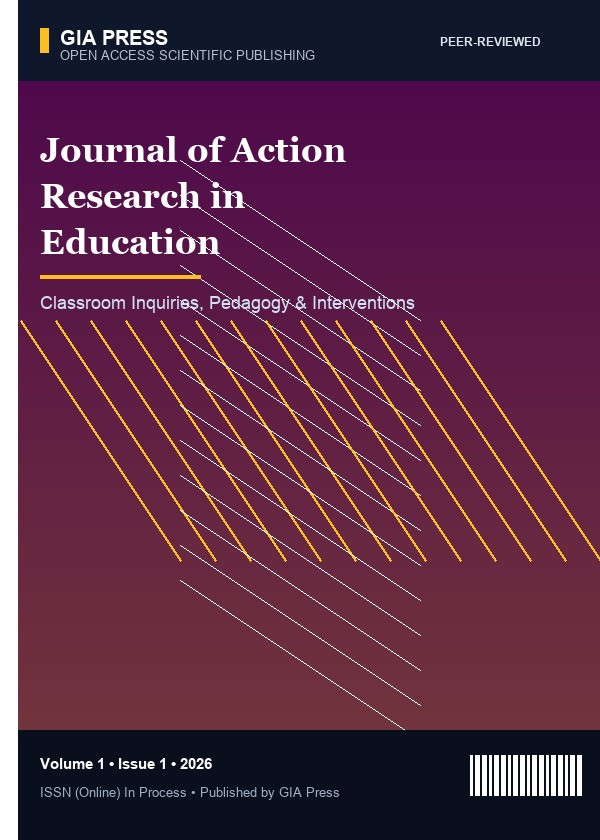
Volume 1, Issue 1 (2026)
Inaugural issue of Journal of Action Research in Education, presenting peer-reviewed empirical studies, methodological models, and educational evaluations. Click below to view the issue's Table of Contents.
Table of Contents • Volume 1, Issue 1 (2026)
3 ArticlesDevelopment of Interactive Learning Media Based on a Snakes and Ladders Lottery Card Educational Game to Improve Students’ Conceptual Understanding in Physics
The Effect of a ChatGPT-Assisted Guided Inquiry Learning Model on Students’ Understanding of Physics Concepts
Ethnoscience-Based Augmented Reality Learning Media and Students’ Scientific Literacy
About Journal of Action Research in Education
Journal of Action Research in Education is an international scholarly publication of Global Innovation & Academic Press (GIA Press).
1. Open Access & Fee Policy (Diamond Open Access)
Journal of Action Research in Education operates under the Diamond Open Access model. There are no submission fees, no editorial processing charges, and no Article Processing Charges (APCs) for authors. All articles are published open access and made freely accessible worldwide immediately upon publication without subscriptions or paywalls.
2. Double-Anonymous Peer Review Process
All submitted manuscripts undergo an initial editorial check for scope, originality, and formatting, followed by rigorous double-anonymous review by at least two independent expert peer reviewers. The reviewers and authors remain anonymous to each other throughout the evaluation process.
3. Publication Ethics & Malpractice Statement
The journal adheres strictly to the Core Practices established by the Committee on Publication Ethics (COPE). Plagiarism, data fabrication, redundant publication, and citation manipulation are strictly prohibited. All submissions are automatically screened for similarity using Turnitin / iThenticate prior to reviewer assignment.
4. Artificial Intelligence (AI) Policy
In accordance with COPE and DOAJ standards, generative AI tools cannot be listed as authors. Authors must transparently disclose any substantive use of AI technologies in the manuscript method or declarations section, specifying the tool used and the purpose of usage.
5. Copyright, Licensing & Self-Archiving
Authors retain copyright in their work and grant the publisher a non-exclusive license to publish. All articles are distributed under the terms of the Creative Commons Attribution 4.0 International License (CC BY 4.0). Authors may deposit preprints, accepted manuscripts, and the published version in any repository immediately (Green Open Access).
6. Digital Preservation
Content published in Journal of Action Research in Education is preserved digitally through scheduled off-site backups, PKP Preservation Network (PN), and national deposit repositories to ensure permanent scholarly accessibility.
7. Institutional Affiliations & Academic Collaboration
Journal of Action Research in Education is published by Global Innovation & Academic Press (GIA Press) in official academic partnership and institutional affiliation with:

Contact & Support
For questions regarding manuscript submissions, editorial queries, indexing, or ethical inquiries, please reach out to the editorial team.
Editorial Office
Editorial Secretariat: Journal of Action Research in Education
Email: editorial@giapress.com
Phone/WhatsApp: +62 852-1234-5678
Office Hours: Monday – Friday, 08:00 – 17:00 WITA
Publisher & Editorial Office
Secretariat Office: Jl. Soekarno-Hatta Km. 9, Tondo, Palu
Central Sulawesi 94118, Indonesia
Portal: https://giapress.com
Technical Support: support@giapress.com